SCIENCE & HUMANITIES DEPARTMENT
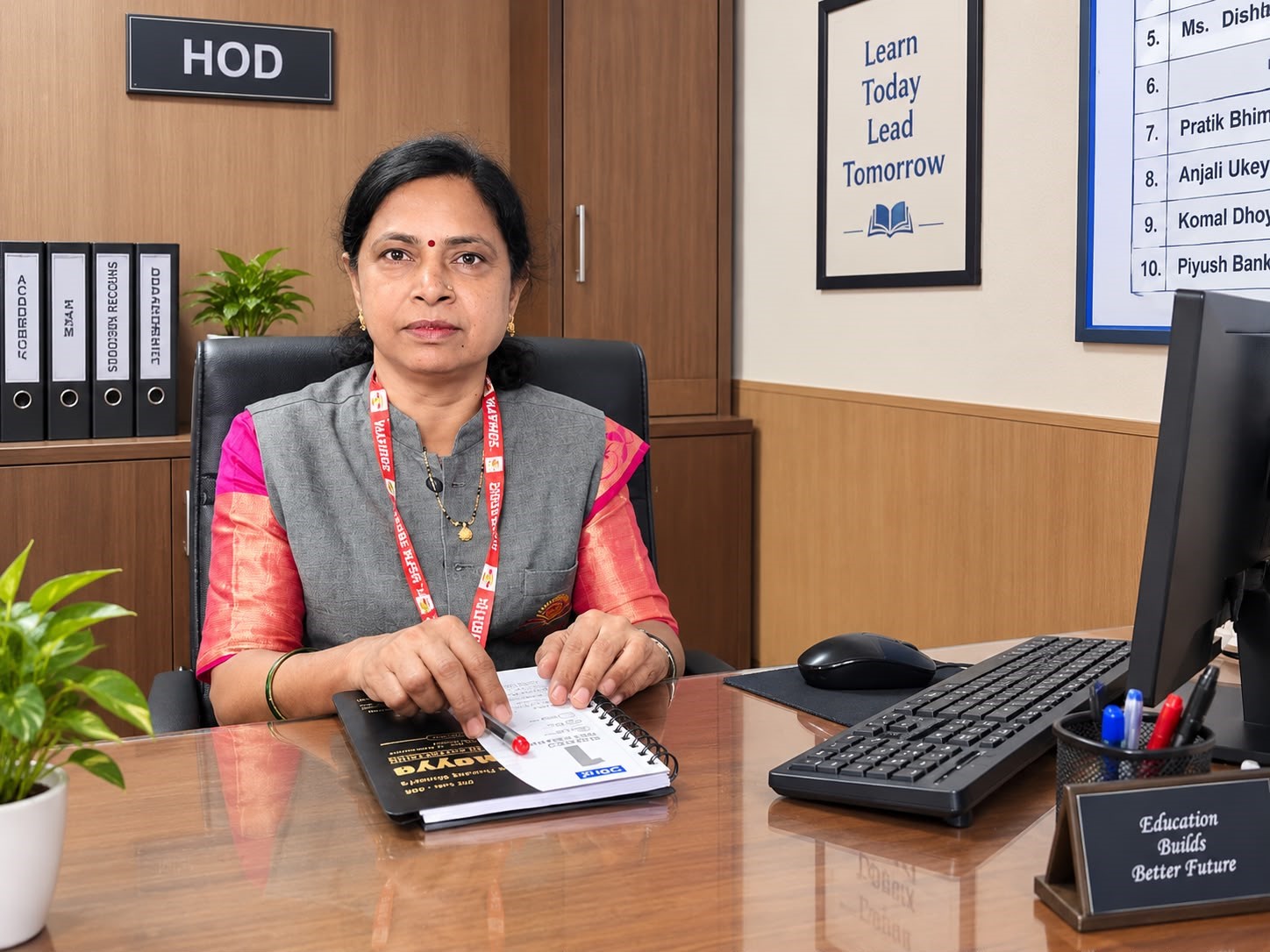
Mrs. Vidya Sanjay Yamalwar
(M.Sc. – Mathematics)
(HOD, Science & Humanities Department)
Teaching Experience:- 15 Years
Science and Humanities, the foundation part of technological development, is significant to all engineering disciplines. Since time unknown, science has been practiced and used to develop many tools of human comfort. With the advent of modern, interdisciplinary aspects of technologies, the role of science stands tall in research and development.
Composed of the disciplines of Physics and Chemistry, the scientific aptitude is meant for the deployment of methodologies in students that are fundamental to the advances of the new world. Generally all that means has matter or energy or both, and the laws, hypotheses and concepts related to them are what science deals with. Physics broadly polishes the energy-related aspects while Chemistry discusses the relations of matter.
Extensions of technological subjects such as aeronautics and instrumentation have their roots deep in physics. Domains like dyes, polymers and chemicals of agricultural importance have the support of chemistry.
Mathematics, an inevitable discipline, is what one cannot think of without. Systematic approach, aptitude and logic are the beneficiaries of core mathematics.
The correct representation of knowledge and understanding is necessary for the successor in research and development tasks. The aspect of humanity deals with the maturing of language skills, learning mannerism, and gaining a justifiable attitude.
Vision of the Institute
To develop industry-ready, ethical diploma engineers through quality technical education and lifelong learning for societal progress.
Mission of the Institute
- M1: To deliver outcome-based education through modern laboratories, industry-aligned curriculum, and effective learning practices.
- M2: To provide practical training, industry exposure, and employability skills to develop industry-ready diploma engineers.
- M3: To strengthen academic quality through continuous training and professional development of faculty and technical staff.
- M4: To promote ethical values, social responsibility and lifelong learning for societal development.
Subjects Offered
The Science & Humanities department provides foundational courses in the following disciplines.
- Mathematics
- Physics
- Chemistry
- English & Communication Skills
- Basic Engineering / Workshop Practice
Below is a brief explanation of the subjects offered.
Mathematics
Mathematics provides the analytical and logical foundation essential for all engineering disciplines. Students learn algebra, trigonometry, calculus, coordinate geometry and statistics, which are directly applied in engineering problem-solving, design calculations and technical analysis.
Physics
Physics deals with matter, energy and their interactions. It polishes the energy-related aspects of engineering and forms the base for advanced subjects like mechanics, instrumentation, electronics and material science. Laboratory work develops experimental skill and scientific temperament.
Chemistry
Chemistry discusses the relations of matter and is fundamental to domains like dyes, polymers, corrosion, fuels and chemicals of agricultural importance. Practical sessions build understanding of chemical analysis, pH, conductivity and environmental chemistry.
English & Communication Skills
English develops language proficiency, technical writing and professional communication. The Language Laboratory enhances listening, speaking and presentation skills, which are vital for engineers in industry and higher studies.
Basic Engineering
Basic Engineering introduces students to engineering drawing, workshop practice and fundamental engineering concepts, providing the practical foundation needed before they enter their respective diploma branches.
Will The Course Suit Me?
Science & Humanities requires an analytical mind and consistent study habits. Useful attributes include:
What Does the Department Do?
The Science & Humanities department builds the academic foundation for all first-year diploma students. It delivers core courses in Mathematics, Physics, Chemistry, English and Basic Engineering, supported by well-equipped laboratories and experienced faculty.
The department focuses on developing scientific temper, mathematical reasoning, communication skills and ethical values — attributes that every diploma engineer needs regardless of branch.
The foundation built in Science & Humanities opens doors to careers in every branch of engineering. Students can pursue:
Science & Humanities forms the backbone of technical education. A strong foundation in these subjects is essential for success in any engineering discipline, both in India and abroad.
Students who excel in these foundational subjects find it easier to grasp advanced engineering concepts, perform well in competitive exams and adapt to emerging technologies.